Rethinking the interface for identity work
Over the weekend, I was visiting my parents and gave them a preview of Brandi, ESAI 🔮's new college-to-career voice agent.
We sat at the table and gathered around my laptop — in the same formation we’ve used for years to debate college choices, careers, grad school, and big life moves.
For fun, we took on the personas of me and my brothers in college and right after graduation. We let Brandi dig into who we were then — what we were good at, what motivated us, what real opportunities might fit.
We debated which responses actually sounded the most like each of us. My mom was nodding along at the insights that felt most like my brother. I was half leading the agent conversation, half explaining what was happening behind the scenes. My dad was quiet in that way he gets when he’s thinking hard.
A few minutes in, he looked at me and said, “This is an exciting pivot.”
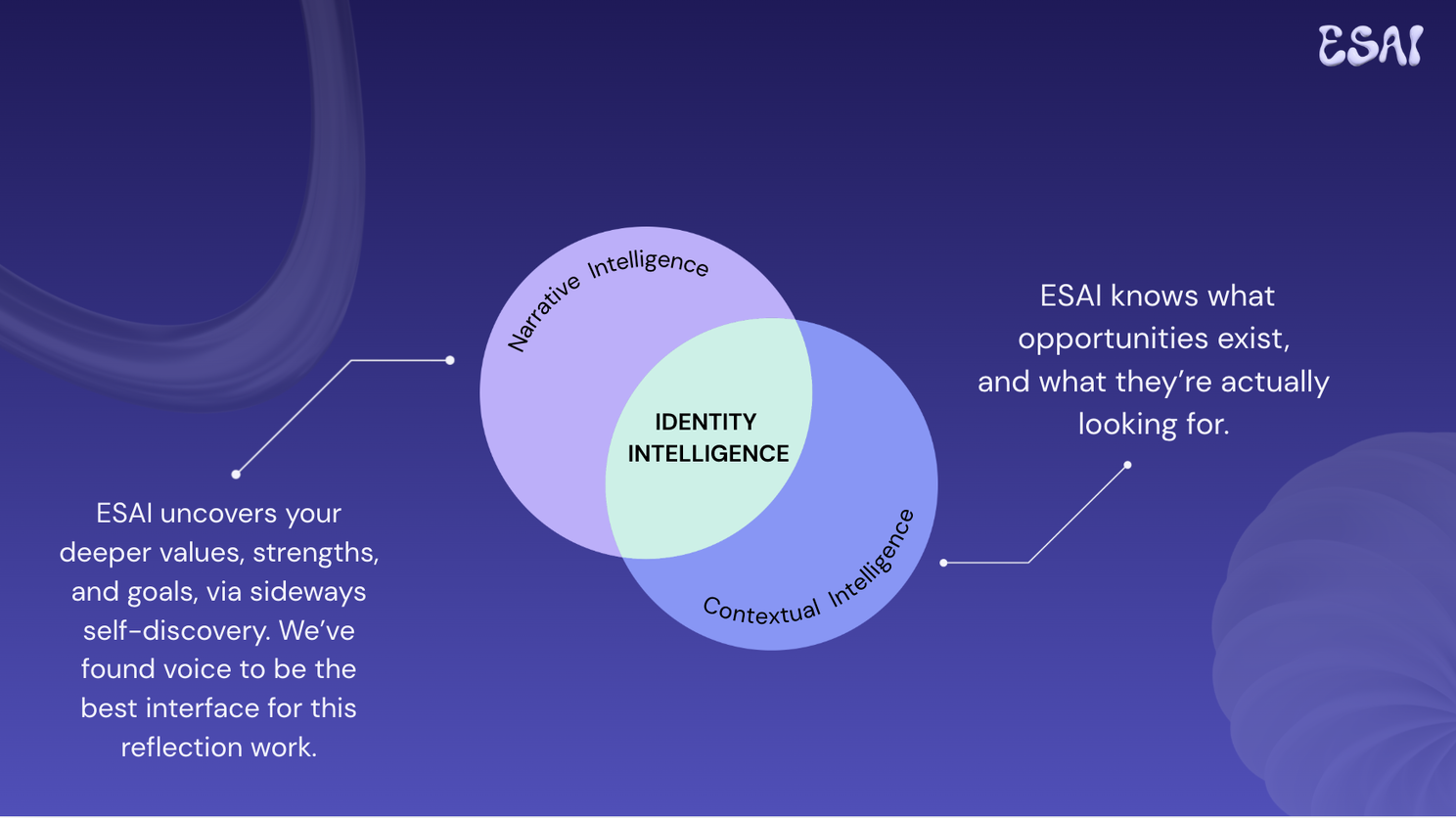
I smiled and pushed back. I disagreed that this was a pivot. The underlying system is the same one we’ve been building for years at ESAI. It still centers self-discovery before decision-making. It still focuses on surfacing patterns before pushing outcomes.
“It just feels different,” he said.
And as 30 years of conversation and debate at the table have taught me — he’s annoyingly perceptive... and usually right.
Over the past couple of years, we’ve built primarily text-based tools for admissions and career exploration. They work. Students reflect, draft, refine, and uncover real signal. But through focus groups and hundreds of hours of testing, we kept noticing something subtle. Interface shapes the depth of reflection. And talking evokes a different feeling than writing.
Typing makes you edit yourself. Writing is performative. Even when a student is being honest, they are aware they are composing. They clean up their thoughts. They round off uncertainty. They try to sound fancy. Most students are performing identity in text.
When a form asks, “What are your strengths?” and the student pauses, “I don’t know” feels like failure. The system doesn’t reward uncertainty. It assumes pre-formed clarity.
But clarity doesn’t precede reflection. It emerges from it. Voice changes the starting point. When a student says “I don’t know” out loud, that is not a dead end. It’s information. It signals that the question is too abstract, too big, or too disconnected from their lived experience. With Brandi, that hesitation becomes a cue.
Instead of repeating the same question, she reframes it. She makes it smaller. She offers a scenario. She meets the student where they are.
If someone struggles to define their strengths, she might ask, “When was the last time someone thanked you for something?” If a student loves sports, she digs into what they pay attention to. Is it stats, strategy, backstories, team chemistry? If someone loves music, she might ask what draws them in. Lyrics? Production? The psychology of the artist?
Students often struggle with abstract prompts. But specific questions unlock memory recall, where identity signals become easier to access. And something interesting happens when that access point is voice.
Students ramble more. They over-explain. They self-correct mid-sentence. They laugh at something they almost dismissed. They say, “This might sound dumb, but…” and then reveal the most important thing.
They forget they are performing. Voice lowers the cost of being unsure.
Last week, I wrote about Sideways Self-Discovery and why we cannot expect clarity without teaching reflection. That philosophy hasn’t changed since the early days of ESAI 🔮. What has evolved is our appreciation for how interface shapes insight.
Voice turned out to be the most natural entry point. It reduces the friction of beginning. And for most young people, beginning is the hardest part.
Next week, I’ll zoom out and share how this evolution in medium enhances what we’ve been building all along. For now, I’m still thinking about my dad’s reaction. “It just feels different.” Sometimes that’s the signal.
**
Brandi is currently in pilot with select university partners. If you're interested in learning more about the future of career placement for your students, shoot us a note!