
Executive Summary
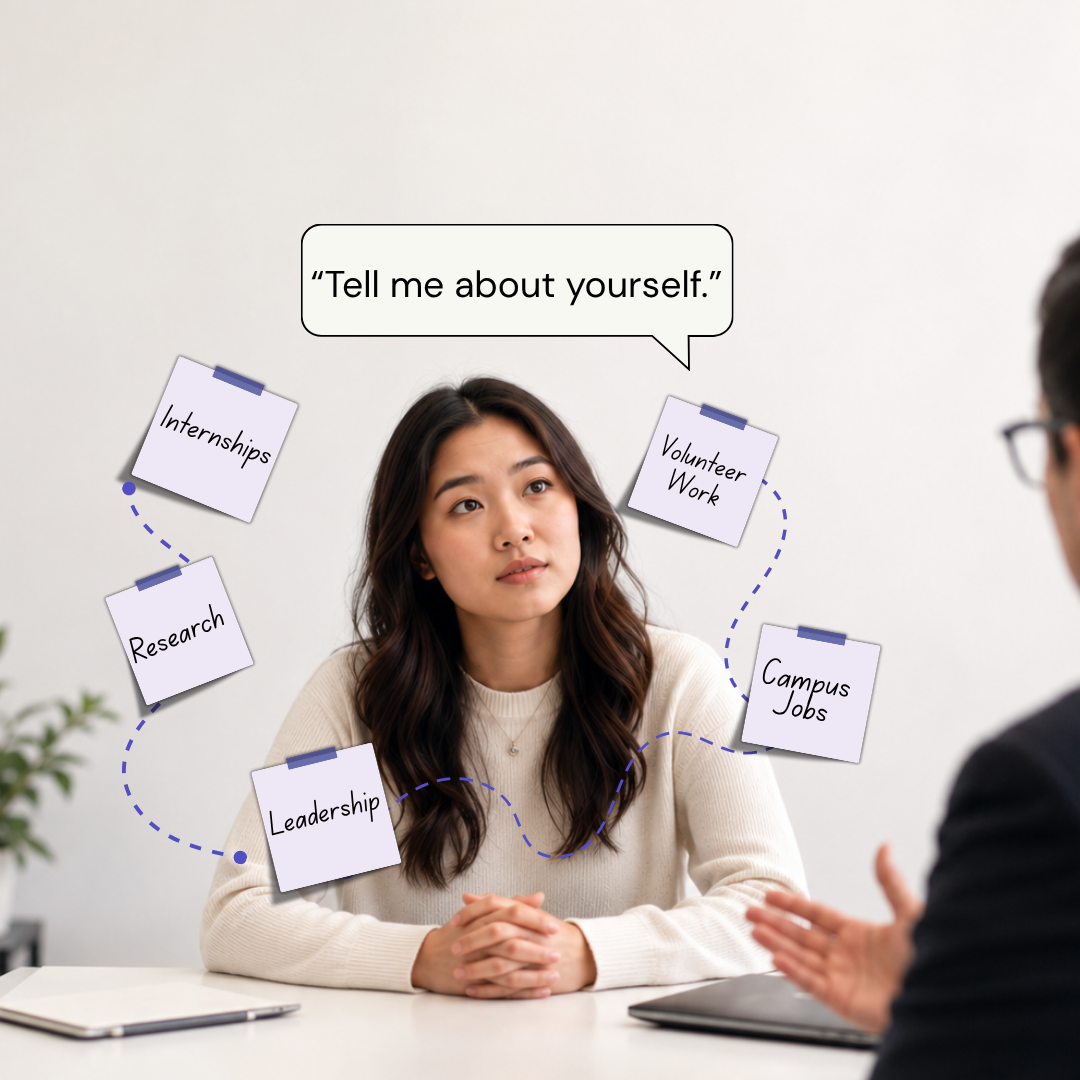
Gen Z is not lacking ability. They are lacking articulation.
They have the skills, experiences, and ambition required to succeed — but many struggle to clearly and confidently communicate who they are and what they bring to the table. At the same time, they are entering a market saturated with AI-generated content, templated resumes, and increasingly commoditized credentials.
Standing out has never been harder.
Or more important.
This paper introduces Identity Intelligence™, the framework behind ESAI, which closes the gap between potential and perception. By combining Narrative Intelligence and Contextual Intelligence — and delivering it through voice-based interaction — ESAI enables students to understand themselves, align with real opportunities, and communicate their value in a way that resonates.
1. The Problem: Ability ≠ Articulation
Across education and hiring, a consistent pattern is emerging: students are prepared, but not positioned.
According to the National Association of Colleges and Employers (NACE, 2024), employers consistently rank communication skills among the most critical — yet most lacking — competencies in early career candidates.
Similarly, LinkedIn workforce insights show that “soft skills” like communication and self-expression are now primary differentiators in hiring decisions.
At the same time, access to knowledge and skills has expanded dramatically. Platforms, bootcamps, and AI tools have made it possible to acquire technical capabilities faster than ever before.
The result:
- More students graduating with similar degrees
- More candidates with overlapping skill sets
- Less differentiation on paper
In this environment, the ability to articulate value becomes the advantage.
Yet most students are never explicitly taught how to do this (Jackson & Wilton, 2019).
2. The Market Shift: The Rise of “Polished Sameness”
Gen Z is coming of age in a world where originality is increasingly outsourced.
AI tools can now generate essays, resumes, cover letters, and responses in seconds. While this increases efficiency, it also creates a new challenge: homogeneity.
Research from McKinsey & Company (2021) and the World Economic Forum (2025) highlights how automation and AI are reshaping the nature of work, placing greater emphasis on human differentiation — including communication, judgment, and self-awareness.
When everyone has access to the same tools:
- Outputs begin to look the same
- Signals become harder to interpret
- Authenticity becomes the differentiator
In other words:
When everything sounds polished, what stands out is what’s real.
3. The Insight: Identity Exists — But It Isn’t Extracted
Students are not blank slates.
They already have:
- Experiences
- Values
- Motivations
- Patterns of behavior
But these are rarely structured, surfaced, or translated into meaningful narratives.
This aligns with research in narrative psychology, including the work of Dan McAdams, which shows that individuals form identity through internalized life stories — not static traits or credentials.
The issue is not lack of identity.
It is lack of structured reflection and articulation (Jackson & Wilton, 2019).
4. Why Voice Changes Everything
Most current tools rely on forms, prompts, or written inputs.
But identity is not naturally formed through forms — it is formed through expression.
Research in Cognitive Psychology demonstrates that verbal processing improves recall, clarity, and meaning-making. The Self-Explanation Effect further shows that individuals better understand concepts when they explain them out loud.
Conversation introduces:
- Nuance
- Emotion
- Spontaneity
- Depth
These are precisely the elements missing from templated inputs.
This is why ESAI’s voice agent, Brandi, is central to the system.
Through conversation, students surface insights they would not uncover through static forms.
5. The Framework: Identity Intelligence™
Identity Intelligence is the system that translates who a student is into how they show up in the world.
It consists of two core components:
Narrative Intelligence
The ability to understand and articulate one’s identity.
- Surfaces strengths, values, and motivations
- Identifies patterns across experiences
- Reflects a student’s story back to them clearly and authentically
This is where self-awareness is built.
Contextual Intelligence
The ability to understand different environments.
- Interprets what specific audiences value
- Recognizes signals, expectations, and decision criteria
- Extracts context-specific communication needs
This is where situational awareness is built.
Identity Intelligence (The Fusion)
The ability to contextualize a personal narrative.
- Understand who they are
- Align with relevant opportunities
- Communicate their value effectively in high-stakes moments
This is where personal relevance is built.
6. Real-World Perspective
Employer Perspective
"I am a leader at a credentialing company, so I'll put it plainly: a credential tells you what someone can do, but never why they're the one to bet on. The candidates who break through are the ones who can articulate their own story, and that's a skill we assume people have but rarely teach."
— Jay Chakrapani, Chief Product & Technology Officer, Prometric
Student Perspective
"From the moment I walked through the doors of the Ross School of Business, I immediately realized how difficult it would be to compete against my peers for club leadership roles, recruiting, and internships. In pursuit of these things I needed to be able to set myself apart from the rest, and talking through my skills and achievements with Brandi allowed me to articulate exactly what makes me different."
— Elle Ervin, Undergraduate Student at the University of Michigan Ross School of Business
Academic Perspective
“As a member of a medical school admissions committee and director of a post-baccalaureate pre-health program, I see the ‘Articulation Gap’ play out every cycle. Many applicants are academically qualified and have meaningful clinical and service experiences, yet they struggle to clearly communicate what distinguishes them or why they are called to medicine. In a highly competitive process, the inability to effectively articulate one’s story, purpose, and growth can be the very factor that prevents an otherwise strong candidate from advancing.”
— Ellen C. Miller, Ed.D., CPCC — Center for University Advising, Sr. Assoc. Dean for Pre-Health Advising, Director, Premedical Certificate program, Hofstra University
7. Implications for Education and Hiring
For Institutions
- Improved student outcomes (placement, acceptance, retention)
- Stronger student differentiation in competitive environments
- Scalable support for advising and career services
For Employers
- Clearer candidate signals
- More efficient hiring decisions
- Better alignment between candidate potential and role fit
For Students
- Increased confidence
- Stronger self-understanding
- Higher likelihood of landing meaningful opportunities (Forbes Coaches Council, 2026)
8. Conclusion: From Potential to Signal
In an AI-driven world where skills are increasingly accessible, they are no longer enough.
What matters is:
- How those skills are understood
- How they are communicated
- How they are perceived
Story is no longer a “nice to have.”
It is the signal.
Identity Intelligence is the system that builds that signal.
By helping students understand themselves, align with the right opportunities, and communicate their value with clarity and relevance, ESAI transforms potential into outcomes.
And in a world of polished sameness —
that difference is everything.
Works Cited
McKinsey & Company. (2021). The skills revolution and the future of learning and earning. https://www.mckinsey.com/~/media/mckinsey/industries/education/our%20insights/the%20skills
%20revolution%20and%20the%20future%20of%20learning%20and%20earning/the-skills-revolution-and-the-future-of-learning-and-earning-report-f.pdf
World Economic Forum. (2025, January 8). Future of jobs report 2025: Jobs of the future and the skills you need to get them. https://www.weforum.org/stories/2025/01/future-of-jobs-report-2025-jobs-of-the-future-and-the-skills-you-need-to-get-them
National Association of Colleges and Employers. (2024). Their words, their worries: A grounded look at career readiness from the student perspective. https://www.naceweb.org/career-readiness/competencies/their-words-their-worries-a-grounded-look-at-career-readiness-from-the-student-perspective
Jackson, D., & Wilton, N. (2019). Can students be taught to articulate employability skills? International Journal of Educational Development, 67, 1–11. https://doi.org/10.1016/j.ijedudev.2019.102079
Forbes Coaches Council. (2026, February 6). Bridging the gap: How to prepare college graduates for the workforce. Forbes. https://www.forbes.com/sites/forbeseq/2026/02/06/bridging-the-gap-how-to-prepare-college-graduates-for-the-workforce/